
Bringing a Large Crown Under Control
Tree Topping and Crown Reduction in Indianola for mature trees growing too close to roofs, power lines, and structures
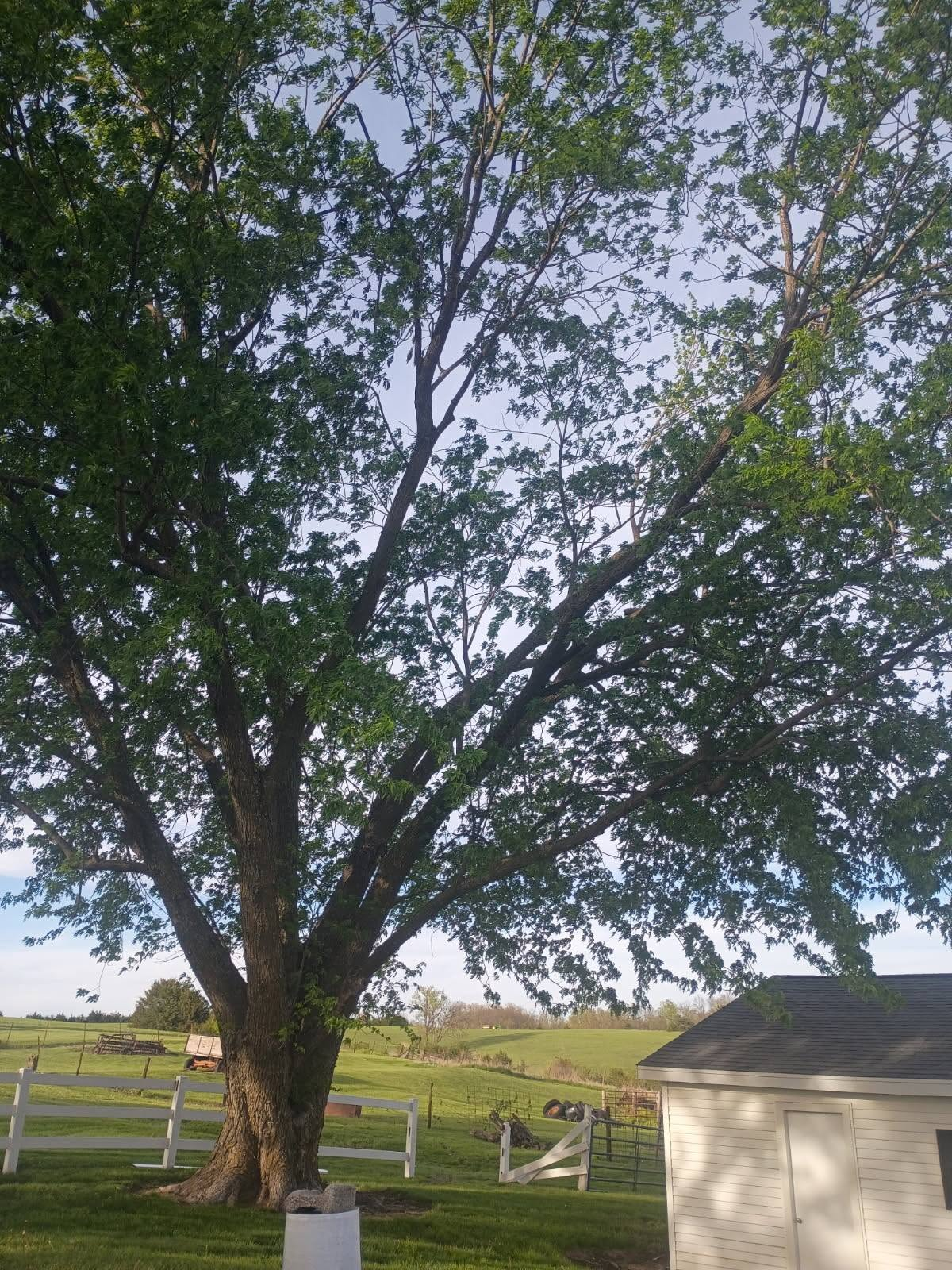
Mature trees in older Indianola neighborhoods were often planted when the house was new, when the lot had room and the tree was small. Several decades later, those same trees have developed canopies that extend over rooflines and toward power lines, and the question becomes how to bring the crown down in a controlled way without removing the tree entirely. Blacks Family Tree Services performs crown reduction and tree topping in Indianola and nearby towns when the goal is keeping the tree standing while reducing the hazard and spread of its canopy.
The critical detail in this kind of work is where the cuts are made. Cuts placed at the branch points, where one limb divides from another, leave the tree with a natural growing point to continue from. Cuts made mid-stem, away from any branch union, leave a stub that cannot seal over properly and becomes a point of decay and weakness over time. The owner climbs the tree to make those cuts from the correct positions rather than working exclusively from a lift that restricts access to the upper canopy, which is where the clearance work almost always needs to happen. Brush from the reduction is hauled off the property as part of the job.
Schedule a consultation to look at the tree and determine how much crown can realistically be removed while keeping the structure healthy and stable.
How Crown Reduction Addresses the Problem
Crown reduction is not the same as simply cutting the top off a tree. A proper reduction identifies the branch structure first, then removes the outer portions of the canopy back to lateral branches that are large enough to take over as the new growing tips. The result is a canopy that is smaller in overall spread and height but still retains the branching pattern that gives the tree its structural integrity. Topping, by contrast, removes the entire upper section regardless of branch position, which can be appropriate when a tree has already lost its upper structure to storm damage or disease and the goal is managed decline rather than long-term retention.
After the crown work is finished, the clearance between the canopy and the roofline or power line becomes immediately visible and measurable. Blacks Family Tree Services removes all the cut brush so the yard is clear, and the remaining tree will show the reduced profile without a collection of stubs at the cut points that would otherwise signal improper technique.
How much the crown can be reduced in a single session depends on the size and species of the tree. Removing more than roughly a third of the live canopy at once puts a significant stress load on the tree, and for large mature trees that are otherwise healthy, a phased approach spread over more than one growing season may be the better plan. That recommendation comes out of the site assessment rather than a one-size rule applied to every job.
What Property Owners Ask About the Work
These questions address how crown reduction and topping are performed, including the decisions that determine whether a tree stays healthy after the work is done, which matters especially on the mature residential trees common throughout Indianola.
Why does cut placement matter so much in crown reduction?
A cut made at a branch union leaves a collar of living tissue that can close over the wound. A cut made in the middle of a stem removes that collar and leaves open wood exposed to decay, which can travel down into the trunk over time and compromise the structural integrity of the tree.
How does the owner climbing the tree differ from working from a lift?
A lift positions the operator at the edge of the canopy but cannot reach into the interior branch structure where the key cuts need to be made. Climbing allows the arborist to position at each branch union and make the cut from the correct angle, which is what determines whether the reduction heals properly.
When is topping more appropriate than crown reduction?
Topping is the right approach when a tree has already lost its leader or upper structure to storm or disease and the goal is to manage what remains rather than preserve a healthy crown. In those cases, the branch points the reduction would normally use are already gone, and a controlled top removal manages the decline safely.
What should a finished crown reduction look like from the ground?
The canopy should still have a recognizable branching structure without flat, stub-filled edges. The overall profile will be smaller and the roofline or structure below more visible, but the tree should not appear as though it was simply cut square at a set height.
How do mature trees in Indianola's older neighborhoods typically respond after crown work?
Trees that have been reduced at proper branch points generally push new growth from those cut ends within the next growing season. The new growth will need monitoring over subsequent years, and in some cases a follow-up reduction may be appropriate once the canopy has re-established to a manageable spread.
Blacks Family Tree Services also performs crown reduction and topping in Norwalk, Creston, Winterset, Osceola, and Chariton. To discuss the specific tree you are working with and what the reduction should accomplish, call (641) 572-2268 to arrange a site visit.