
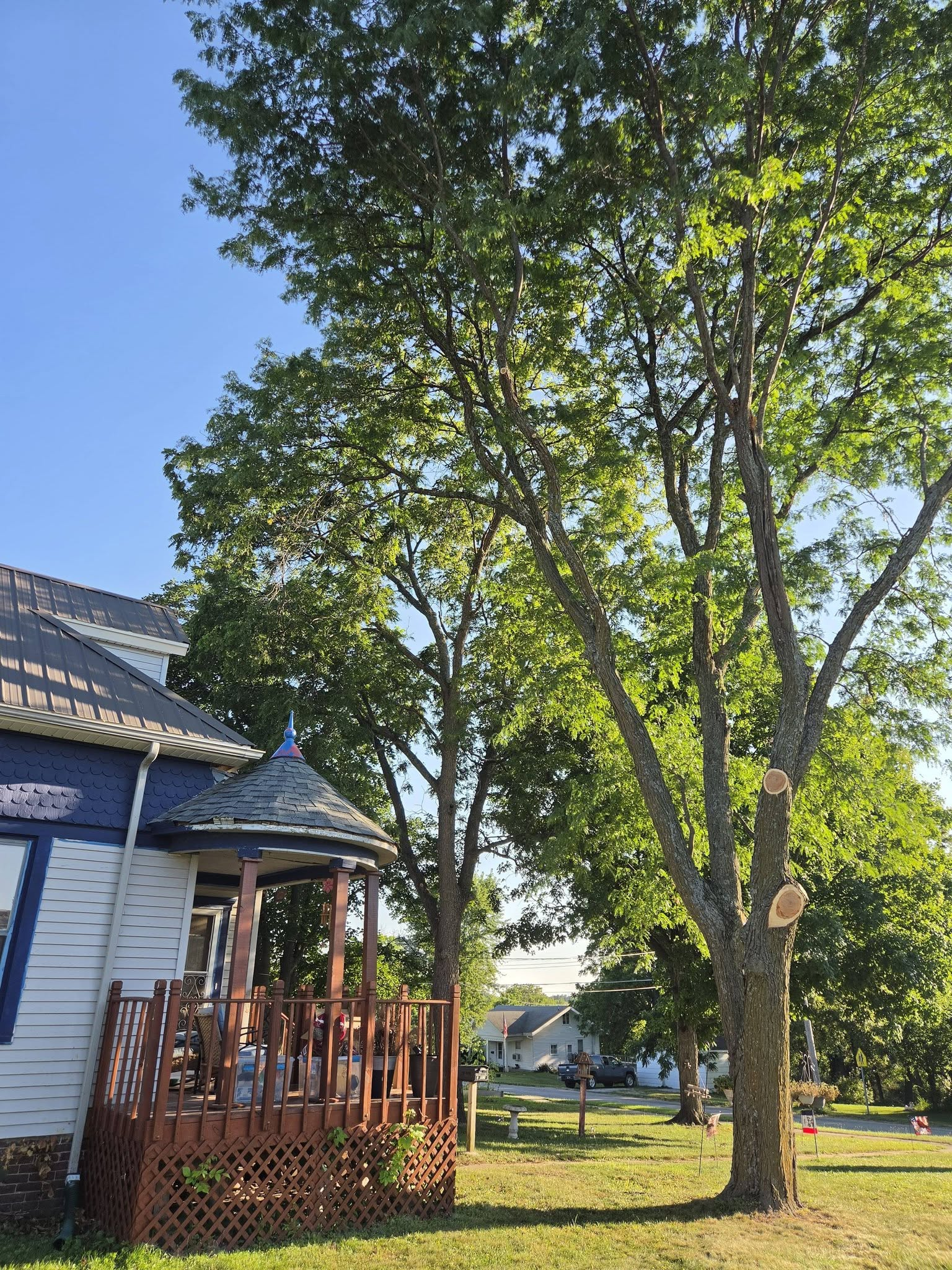
Mature Trees Shaped Without Damage to Structure
Pruning and shaping in Indianola for mature shade trees growing too close to garages, sheds, and neighboring fences
Yards on older lots across Indianola and the surrounding communities frequently contain mature shade trees that were planted when the lot was newer and had more room to spare. Those trees have grown to a point where their canopy now overhangs a garage, presses against a neighboring fence, or extends past a shed roofline in ways that require active management rather than simple neglect. Blacks Family Tree Services prunes and shapes trees in these conditions, making cuts at the correct structural points so the tree stays healthy and holds its new form rather than pushing out weak regrowth at every cut site.
The process starts by identifying which limbs are driving the problem—whether that is canopy weight pulling a major branch toward a structure, interior crossing limbs creating friction and eventual wounds, or lateral growth that has extended past the edge of the property. Cuts are made back to a proper point rather than left as stubs, which is the detail that separates shaping work that lasts from trimming that produces a new problem in two seasons. All brush is hauled away at the end of the job.
Schedule an evaluation to walk through which limbs need to come back and how the shaping would be sequenced across the tree.
What Proper Pruning Actually Requires
Shaping a mature tree involves more than identifying which limbs look too long. The structural relationship between a limb and its parent branch determines where a cut should be made—removing a limb at the branch collar rather than beyond it allows the tree's vascular system to compartmentalize the wound and begin sealing it. Cuts made in the wrong location leave exposed wood that cannot seal properly, and that exposed tissue becomes an entry point for decay organisms. On a tree that is already under stress from being crowded by structures, that distinction matters for how long the tree remains viable.
After pruning and shaping work is completed, the visible change to the tree is specific: the canopy sits back from the structure it was encroaching on, the crown has a more deliberate form without the irregular extensions that were driving the problem, and the cut points on removed limbs show clean collars rather than ragged stubs or protruding wood. Blacks Family Tree Services makes before-and-after photos available on request so homeowners can see finished work on properties with comparable lot conditions and tree sizes.
Shaping is also a different task depending on whether a tree is being brought back from years of neglect or maintained on a regular cycle. A tree that has not been pruned in a decade may require a more careful approach—removing too much in a single session stresses the tree, so some situations call for staged work over more than one visit rather than a full correction at once. The site evaluation identifies which approach fits the condition of the tree before any cuts are made.
What Property Owners Ask About the Work
Pruning and shaping questions often come from homeowners who have watched a tree outgrow its original position over many years and are not sure where to start. These questions address the core decisions involved in the work.
Why does cut placement matter when removing a limb during shaping?
A cut made at the branch collar—where the limb meets its parent branch—preserves the tissue the tree uses to close over the wound, while a cut made beyond that point leaves exposed wood the tree cannot seal, which invites decay and long-term structural problems.
How is the sequence of cuts decided when shaping a mature tree with multiple problem limbs?
The largest structural limbs are typically evaluated first to determine whether removal of one limb changes the balance and load distribution of the rest of the canopy, since that sequencing affects how much additional work is needed and which cuts are made in which order.
What causes a shaped tree to push out dense, weak regrowth at the cut points within a season or two?
Stub cuts—cuts made beyond the branch collar rather than at it—trigger a stress response in some species, producing clusters of fast-growing shoots called epicormic growth at the cut site, which typically need to be managed again within a few years.
How does a crowded older lot in Leon or the surrounding Decatur County area change the approach to tree shaping?
Older properties in those communities often have mature trees positioned very close to fences, sheds, and neighboring structures with minimal clearance, which limits equipment access and requires that limb removal be sequenced to avoid dropping cut material onto adjacent property or structures.
What should the finished work look like once pruning and shaping is complete?
The canopy should have a coherent form without abrupt stubs or ragged cuts at limb removal points, the cleared space between the tree and any adjacent structure should be measurably open, and the cut surfaces should show clean, smooth faces where each limb was removed at its collar.
Blacks Family Tree Services also prunes and shapes trees in Creston, Norwalk, Winterset, Osceola, and Chariton. To discuss the specific trees on your property and what the shaping work would involve, call Blacks Family Tree Services at (641) 572-2268.