
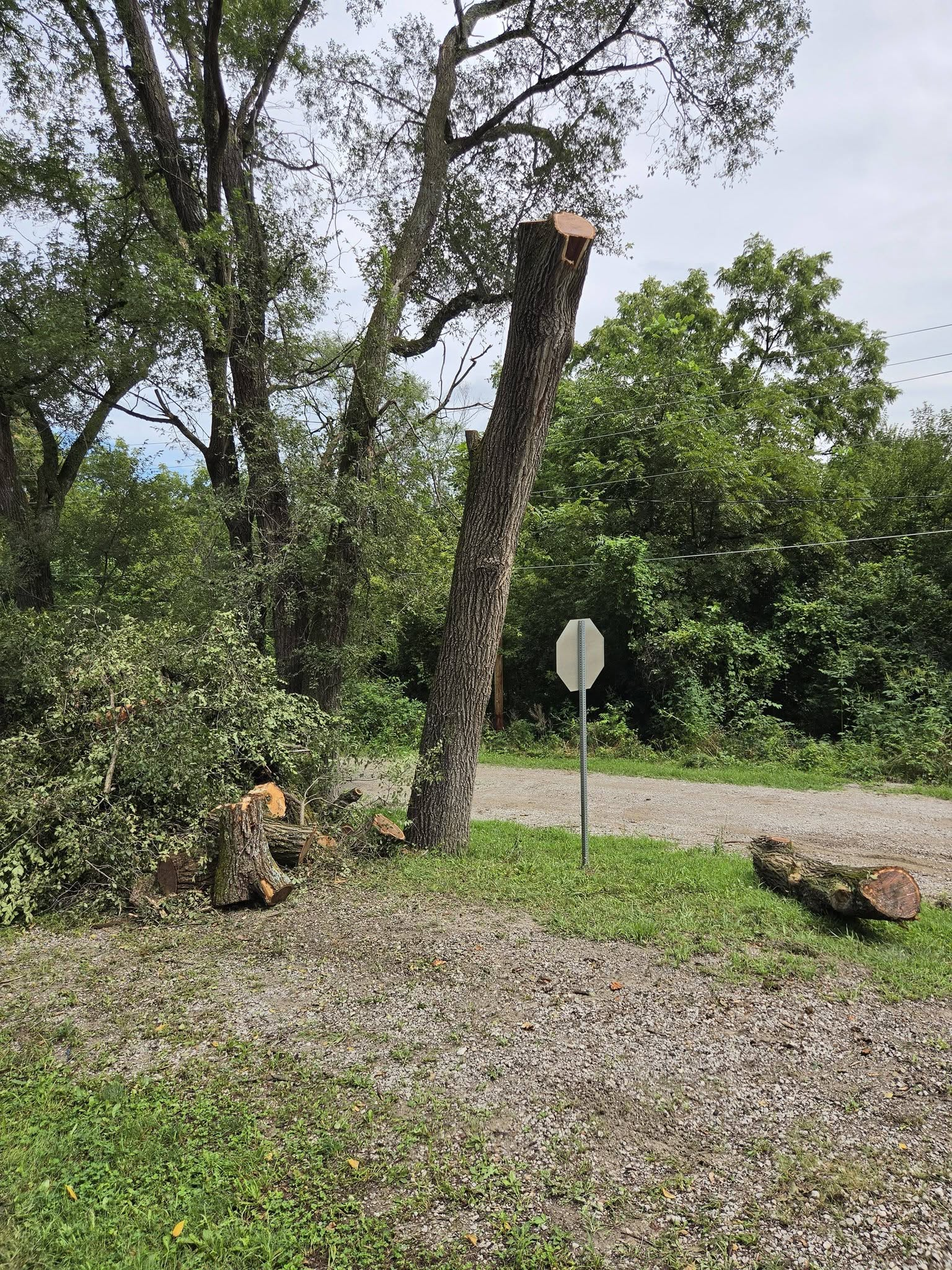
When the Tree Has to Come Down
Tree Removal in Indianola for large trees over roofs, near structures, and in tight lots where equipment cannot reach
Older houses in Indianola tend to sit on narrow lots where large trees have grown up behind the house, over the roofline, and close enough to power lines that standard bucket-truck access simply is not possible. Blacks Family Tree Services removes those trees, working in the conditions that define properties in this area rather than the open yards that make removal straightforward. If you are looking at a tree that has grown too large for the space around it, this is the work the business is built to handle.
The process starts with reading the site: what is overhead, what is on the ground, and which direction the tree can safely move in pieces. For trees up to about 60 feet, the work includes topping out the canopy first, then working down through the trunk in sections to keep control at every stage. Brush and debris hauled off the property are part of the job, not an add-on, and stumps can be ground or fully removed once the trunk is down. Before-and-after photos from completed jobs are available to show how that sequencing looks in practice on lots similar to yours.
Request an on-site evaluation so the specific site conditions, tree height, and access constraints can be reviewed before any work begins.
What Controlled Removal Actually Involves
When a tree sits close to a structure and a truck cannot get in to do the heavy lifting, removal shifts to a climb-and-section approach. The climber works up into the canopy and cuts from the top down, directing each piece away from the roof, fence, or adjacent structure before it is dropped. That sequencing is what separates a controlled removal from a felling operation, and it is why the site assessment matters before a single cut is made.
Once the tree is down, what you will notice immediately is that the debris is gone. Blacks Family Tree Services hauls brush and wood off the property as part of the job, so the yard is clear rather than stacked. If stump grinding follows, the remaining mound of chips can be raked into the surrounding soil or removed, leaving the ground level enough to seed or replant.
Stump work is a decision point worth thinking through before the job starts. Grinding removes the visible stump and the surface roots, but the taproot decays on its own over time. Full stump removal digs deeper and is appropriate when replanting in that exact spot. Discussing both options at the estimate stage means the right scope is set before anything is cut.
What Property Owners Ask About the Work
The questions below focus on how tree removal is actually performed, particularly on the kinds of tight, mature lots common in Indianola and the surrounding area.
What makes a tree removal difficult on a small or restricted lot?
When there is no clear drop zone, removal requires sectioning the tree from the top down rather than felling it in one direction. Each cut is planned to land in a controlled area, which takes longer but protects structures, fences, and utility lines nearby.
How is a large tree taken down without a crane or bucket truck?
The climber ascends and works down through the canopy in sections, using rigging lines to control where each piece lands. This method works on trees up to about 60 feet and does not require vehicle access to the base of the tree.
When should a stump be ground versus fully removed?
Grinding is sufficient when the area will be replanted with grass or left as open ground. Full removal is the better choice when a new tree, garden bed, or hardscape will go in the same footprint, since grinding leaves the root system in place to decay.
How do you tell whether a tree near a power line can be sectioned safely?
The line clearance and the angle of the branches determine whether climbing is safe and where cuts have to be made first. In Indianola, older residential lots frequently have trees that have grown into or past utility lines, and that proximity changes the sequence of cuts rather than the decision to remove.
What does the yard look like after removal and debris hauling?
The trunk sections, brush, and limbs are loaded and removed from the property as part of the job. What remains is the stump at ground level and any disturbed soil around the base, which can be addressed with grinding or removal as a follow-on step.
Blacks Family Tree Services also removes trees in Norwalk, Creston, Winterset, Osceola, and Chariton. The business runs on referrals from past customers, and photos of completed removals are available to review before you commit to a scope. To get started, call (641) 572-2268 to set up a site visit for your property.